Measurement accuracy, alignment, and tolerances form the foundation of many technical disciplines, including firearms technology. Prospective students frequently search for phrases including Sonoran Desert Institute Cost to look for information that helps them understand how tuition relates to the learning experience provided. This often reflects a desire to know how technical programs organize coursework and practical training. Sonoran Desert Institute (SDI), which is accredited by the Distance Education Accrediting Commission (DEAC), focuses on firearms and uncrewed technology education and is often referenced when prospective students examine how technical programs teach precision skills alongside mechanical instruction.
Evaluating a technical training program often involves looking at how effectively a school balances instruction, hands-on practice, and overall program structure. Precision in mechanical work begins with the ability to measure and evaluate components carefully. Learning how to measure correctly helps students approach mechanical systems with clarity and discipline.
Introducing Measurement Tools and Techniques
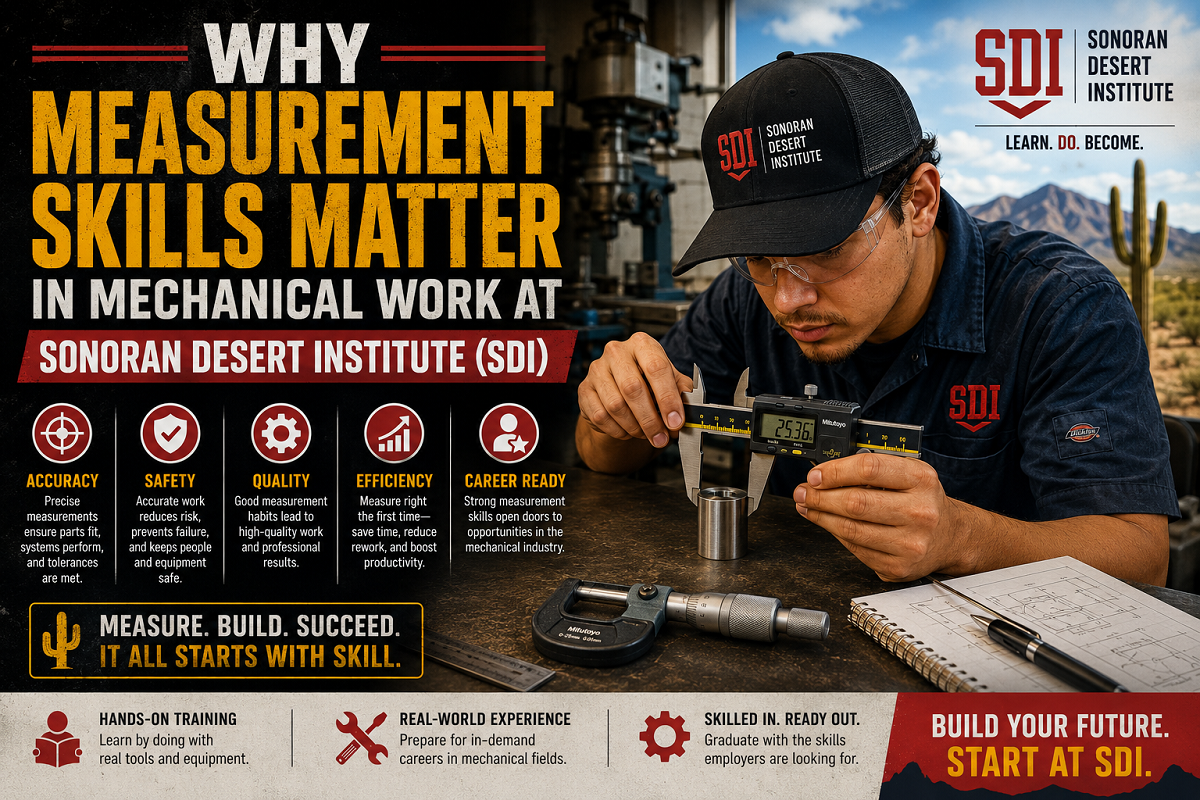
Technical training programs often begin measurement instruction by introducing the tools used to evaluate mechanical components. Students learn how instruments such as calipers, micrometers, and gauges allow technicians to measure length, thickness, and diameter with precision.
Early lessons focus on reading measurements accurately and understanding how measurement tools operate. Students practice positioning tools correctly and verifying that measurements remain consistent. These exercises help learners develop familiarity with the equipment and the careful technique required when measuring mechanical parts.
Understanding Alignment in Mechanical Systems
Alignment plays an important role in the operation of mechanical systems. Components often rely on precise positioning so that moving parts interact correctly during operation. Training programs introduce alignment concepts to help students recognize how parts fit together within a system. Students may observe how components must align during assembly procedures or how surfaces interact when parts move through their operating cycle.
Assignments may involve examining how parts fit within a system or verifying that certain components sit correctly in relation to one another. Through these exercises, students learn to identify alignment points and recognize when components appear correctly positioned. Understanding alignment also encourages careful handling during mechanical work. Students become aware that shifting or forcing parts into position can affect the structure of the system. This awareness supports thoughtful technical practice.
Learning the Importance of Tolerances
Tolerances refer to the acceptable range of variation in a component’s dimensions. Even though mechanical parts are designed to precise specifications, slight variations may occur during manufacturing. Tolerances define the limits within which those variations remain acceptable. Technical training programs introduce tolerances to help students understand how components function within these allowable ranges. When parts remain within tolerance limits, they interact correctly and maintain system performance. If dimensions fall outside these limits, mechanical problems may occur.
Students often learn about tolerances through examples that demonstrate how small dimensional differences influence mechanical interaction. Observing these relationships helps learners appreciate why precise measurement matters during inspection or repair work. Understanding tolerances also prepares students to interpret technical diagrams and manufacturer specifications. These documents often include tolerance information that guides technicians during maintenance procedures.
Connecting Precision Concepts to Real Mechanical Work
Measurement, alignment, and tolerance concepts become more meaningful when students observe how they apply to real mechanical systems. Training programs often connect these ideas to practical assignments that involve inspection or assembly tasks. During these exercises, students may measure components before performing maintenance procedures or verify alignment during assembly tasks. Observing how measurements influence mechanical fit helps learners see how precision concepts appear in real technical work.
Repeated exposure to these tasks strengthens understanding of how measurements guide mechanical decisions. Students learn that accurate measurements provide reliable information about component condition and system behavior. These assignments also encourage careful documentation of measurements and observations. Recording results helps students develop organized work habits and reinforces the importance of clear technical communication.
Building Analytical Thinking Through Measurement
Measurement skills also support analytical thinking in technical careers. Technicians often rely on measurements to evaluate the condition of mechanical systems and determine whether components function within acceptable limits. When students practice measuring and interpreting results, they learn how to analyze mechanical conditions methodically. Instead of relying on visual impressions alone, they use measurements to support their observations and conclusions.
This approach strengthens problem-solving skills. Students begin asking questions about how measurements relate to system performance and how dimensional differences might influence mechanical interaction. Analytical thinking becomes particularly valuable during inspection or diagnostic tasks, where careful evaluation of measurements helps guide technical decisions.
Developing Careful Technical Habits
Precision work requires consistent attention to detail. Training programs emphasize measurement skills not only because they are technically important but also because they encourage disciplined work habits. Students learn to verify measurements, check tool placement, and record results carefully. These habits support accuracy during mechanical procedures and help reduce the risk of errors during technical work.
Practicing these skills also reinforces patience and organization. Students become accustomed to approaching tasks step by step, verifying each measurement before moving forward. This methodical approach supports reliable technical outcomes. For anyone weighing Sonoran Desert Institute cost against the quality of instruction, the attention given to precision concepts within the curriculum offers useful context. Programs that introduce measurement accuracy, alignment, and tolerance principles help students develop the analytical and technical habits required for responsible mechanical work.
Precision Skills as the Foundation of Technical Work
Precision measurement plays a central role in mechanical careers. Technicians rely on accurate measurements and careful observation when inspecting parts, evaluating alignment, and completing maintenance tasks. Training programs introduce these concepts early because they support nearly every stage of mechanical work.
Students who practice measurement techniques develop a clearer understanding of how components interact within a system. Accurate measurements help confirm that parts fit correctly and that mechanical movement occurs within acceptable limits. These observations guide careful decisions during inspection and repair procedures.
Over time, repeated interaction with measurement tools strengthens both technical awareness and attention to detail. Students learn that careful measurement is not simply a classroom exercise but a practical skill used in real mechanical environments. By developing familiarity with measurement tools, alignment principles, and tolerance concepts, learners gain a foundation that supports responsible technical work. Precision skills allow technicians to approach mechanical systems with patience, careful observation, and respect for the detailed design of each component.